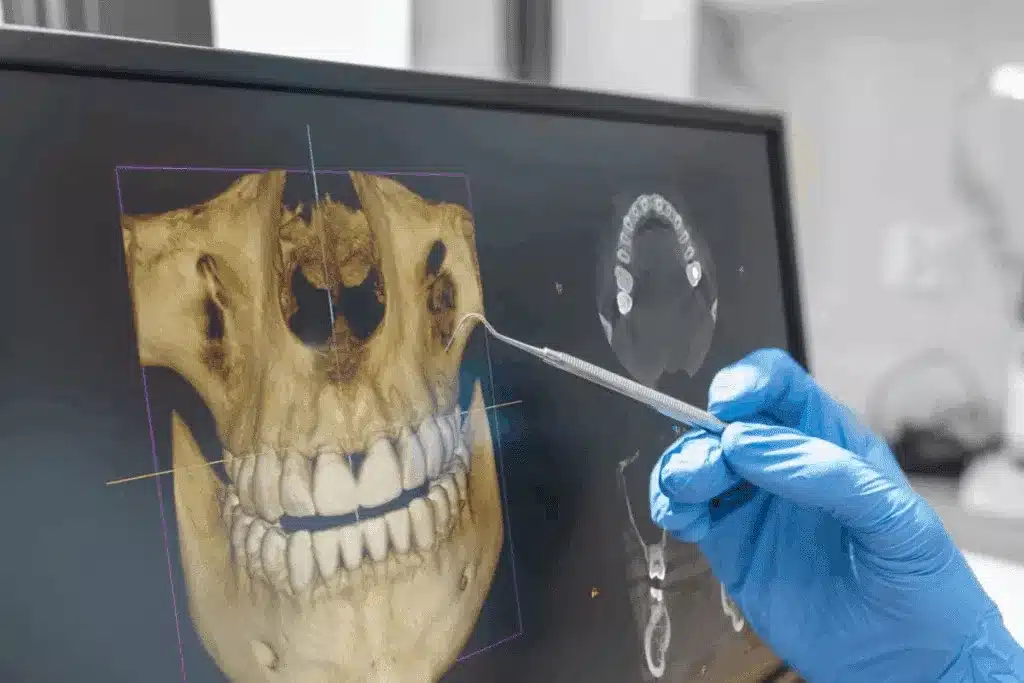
Standard dental X-rays have been reliable diagnostic tools for decades. They show cavities between teeth, bone levels around roots, and the position of unerupted teeth. But they produce a flat, two-dimensional image of three-dimensional anatomy. There are things a 2D X-ray cannot show clearly: the exact depth of a bone defect, the precise three-dimensional position of a nerve canal, or the internal structure of a tooth root from multiple angles.
Cone beam computed tomography, referred to as CBCT, produces a three-dimensional image of the teeth, jaw, and surrounding structures from a single scan. It’s a meaningfully different type of diagnostic information, and at Wave Dentistry in White Rock, it’s part of a fully digital workflow that informs how treatment is planned and carried out.
How CBCT Imaging Works
A CBCT scanner rotates around the patient’s head, capturing hundreds of images from different angles in a single rotation. Software processes those images into a three-dimensional volume that the dentist can navigate in any direction, essentially allowing them to look at the jaw from any angle, isolate specific anatomical structures, and take measurements with a level of precision that flat X-rays can’t match.
The scan takes only about 10 to 40 seconds of exposure time. The field of view can be adjusted depending on what’s being examined, ranging from a focused scan of a single tooth to a full view of the jaw and airway. Radiation dose is significantly lower than a hospital CT scan, though higher than a conventional dental X-ray, and is used when the diagnostic information it provides justifies its use.
Where CBCT Changes What a Dentist Can See
Dental implant planning
Placing a dental implant requires knowing the exact dimensions and density of the available bone at the proposed implant site. It also requires identifying the location of the inferior alveolar nerve in the lower jaw, which runs through the mandible and must be avoided during placement. A 2D X-ray gives an approximate picture. A CBCT scan gives precise measurements in three dimensions.
At Wave Dentistry, dental implant planning uses CBCT data to map the exact position, angle, and depth of implant placement before the procedure begins. This level of pre-surgical planning reduces guesswork and supports a more predictable placement outcome.
Assessing bone structure for multiple procedures
Bone quality and quantity matter beyond implants. For patients being evaluated for extractions, orthodontic movement, or jaw-related concerns, CBCT provides a clearer picture of the underlying structures involved. In TMJ and jaw pain cases, the scan can show the position and condition of the temporomandibular joint in three dimensions, something a flat X-ray cannot reproduce accurately.
Evaluating root anatomy and tooth structure
Some teeth have unusual root anatomy: curved roots, extra root canals, or calcified canal systems that aren’t visible on a standard X-ray. CBCT imaging can reveal these details before treatment begins, allowing the dentist to plan accordingly rather than discovering them mid-procedure.
This is particularly relevant for complex restorative cases or situations where a tooth has had previous treatment and the internal anatomy is unclear.
Airway assessment
CBCT imaging can also capture the airway in three dimensions. For patients being evaluated for sleep apnea or snoring concerns, this view helps identify whether the airway is narrowed and where the narrowing occurs. This information contributes to more targeted treatment planning for airway-related conditions.
How CBCT Fits Into a Fully Digital Workflow
The diagnostic value of a CBCT scan increases when the data can be integrated with other digital information captured at the same clinic. At Wave Dentistry, CBCT imaging works alongside iTero digital scanning, which captures a precise surface model of the teeth and gums. Together, these two data sets can be overlaid to produce a complete picture of both the external anatomy and the underlying bone structure.
This integrated view is what allows for implant planning with a high degree of spatial accuracy, or for treatment planning on complex restorative cases where the relationship between bone, roots, and the proposed restoration all need to be understood together.
The clinic’s 3D printing capability means that surgical guides and planning models produced from this data can be fabricated in-house, rather than relying on external labs with longer turnaround times.
What This Means for Patients
You don’t need to understand the technical details of CBCT imaging to benefit from it. What it means practically is that the dentist examining your case has access to more complete information before making treatment recommendations.
For implant patients, that means a placement plan based on exact bone measurements rather than estimates. For patients with jaw pain or airway concerns, it means a diagnostic view that standard imaging can’t provide. For complex restorative cases, it means fewer surprises during treatment because the anatomy is already well understood.
Wave Dentistry’s investment in this technology reflects a commitment to thorough diagnosis before treatment, not just efficient throughput. The clinic is not positioned as the most affordable option in White Rock. It’s positioned as the practice where the diagnostic and treatment workflow is built around accuracy, and that requires investing in the tools that make accuracy possible.
About Wave Dentistry
Wave Dentistry is located at 1656 Martin Drive, Suite 200, White Rock, BC, and welcomes patients from White Rock, South Surrey, Crescent Beach, Ocean Park, and surrounding South Surrey communities. The practice offers a fully digital workflow including 3D CBCT imaging, iTero scanning, 3D printing, in-house same-day crown milling and glazing, and 3D-printed smile previews for veneer planning.
Wave Dentistry offers direct billing to insurance for patient convenience and accepts CDCP and all Canadian insurance plans. American insurance plans are not accepted.
Book Your Appointment at Wave Dentistry in White Rock
If you have questions about how CBCT imaging applies to your specific dental situation, or you’d like to discuss implants, jaw concerns, or complex restorative care, the team at Wave Dentistry is accepting new patients.
Call (604) 538-9283 to book your appointment.
- Book a consultation at Wave Dentistry in White Rock
- Call us to learn how CBCT imaging supports your treatment plan
- Schedule a dental implant consultation using 3D imaging at Wave Dentistry
- Contact Wave Dentistry to discuss complex restorative or TMJ concerns
- Request your new patient exam at our White Rock dental clinic today